Death’s End Chapter Summaries
Single paragraph summaries of each section of Death’s End
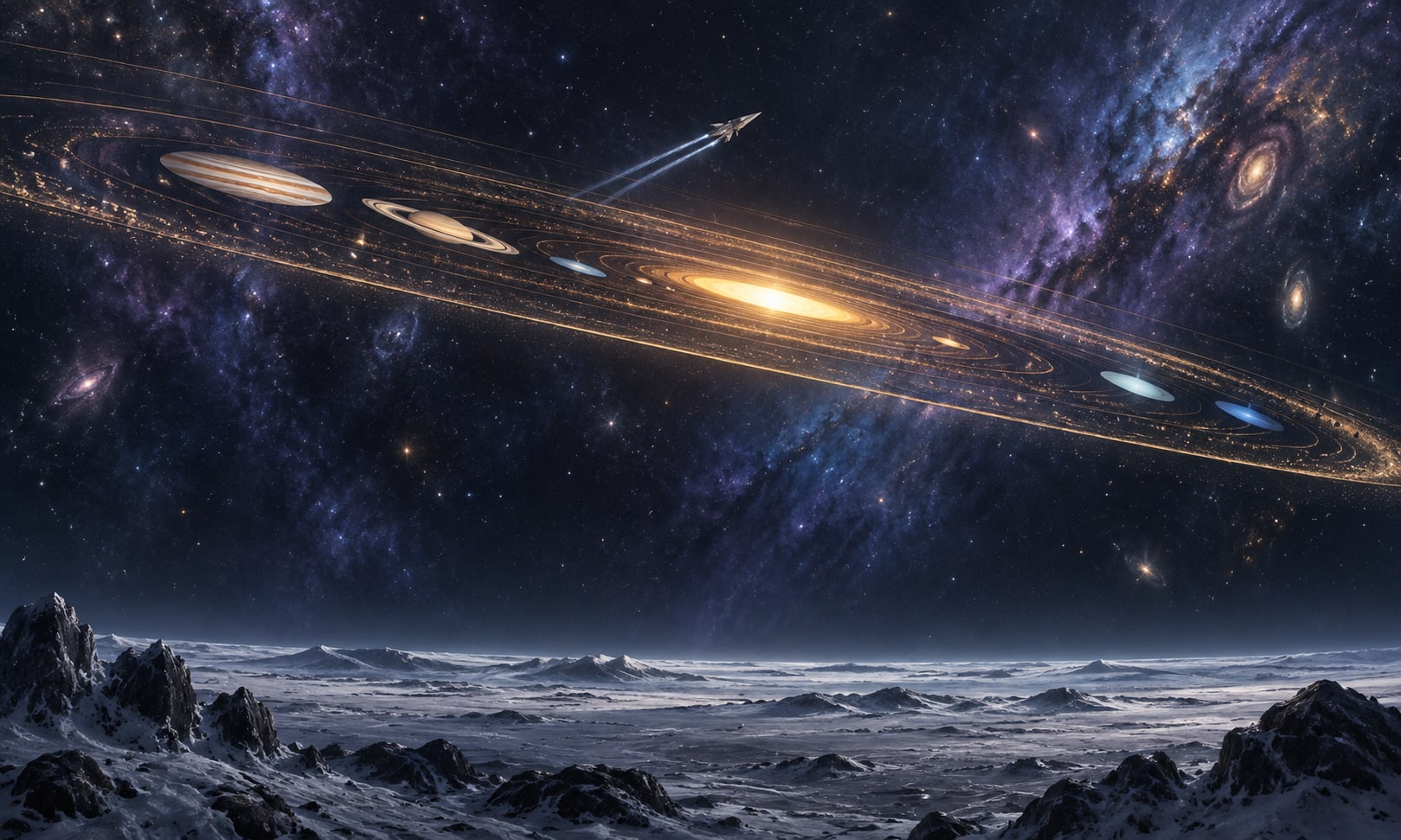
One of my favorite books ever is Death's End. It's the third in the Remembrance of Earth's Past trilogy (comprising Three-Body Problem, The Dark Forest, and Death's End).
In a sense, it's about the implications of a universe full of superintelligences & the terrifying power that comes from unlocking more of physics. The trilogy is also unique in that it's told with an exponentially increasing rate of action, similar to how the arc of technology is shaped - the last half of Death's End has more stuff happen than the first two and a half books do.
Anyway - here's an AI-generated summary of each chapter so you can find the parts you want to re-read.
Part I · Part II · Part III · Part IV · Part V · Part VI
Preface
Excerpt from the Preface to A Past Outside of Time. Cheng Xin introduces A Past Outside of Time as a personal recollection rather than a rigorous history. Writing in a small world where she can reposition the sun and see herself across the horizon, she hopes her account will help someone in a future universe understand the civilization that produced it.
Part I
1. May 1453, C.E. / The Death of the Magician. During the siege of Constantinople, Helena demonstrates that she can remove treasures from sealed chambers and a brain from an intact skull. She offers to assassinate the Ottoman sultan in exchange for royal status, but loses her powers when a passing fragment of higher-dimensional space leaves Earth. She is killed, and Constantinople falls.
2. Crisis Era, Year 1 / The Option for Life. Distraught by the apparent collapse of physics and her discovery of Ye Wenjie’s secrets, Yang Dong visits a computer simulation of Earth’s evolution. Switching off life produces a radically different planet. She begins to wonder whether intelligent life has similarly altered the universe itself, and whether the laws she studies are really natural.
3. Crisis Era, Year 4 / Yun Tianming. Terminally ill Yun Tianming watches a fellow patient undergo euthanasia and considers following him. A former classmate, Hu Wen, gives him money after making a fortune from a drink inspired by Tianming’s suggestion. Still unable to cure his cancer, Tianming decides to spend the money buying a star for Cheng Xin, whom he loved in college.
4. Excerpt from A Past Outside of Time / Infantilism at the Start of the Crisis. This historical interlude explains the UN’s Stars Our Destination Project: selling distant star systems to finance planetary defense and expand the UN’s resources and authority. The scheme attracts almost no buyers and is remembered as an example of humanity’s confused early response to the crisis. Its obscure private purchases nevertheless have lasting consequences.
5. Crisis Era, Year 4 / Yun Tianming. Tianming purchases the distant star DX3906 for Cheng Xin, arranging for the gift to remain anonymous. He then prepares to end his life, remembering his lonely childhood, college years, and missed opportunities with her. His euthanasia procedure is interrupted when Cheng Xin arrives, but she has come with a request he never expected.
6. Crisis Era, Years 1–4 / Cheng Xin. The story returns to Cheng Xin’s recruitment into the Planetary Defense Council’s intelligence agency, led by Thomas Wade. Asked how to send a probe toward the approaching Trisolaran fleet, she proposes a sail accelerated by a succession of nuclear explosions. When the proposal meets resistance, Wade raises the stakes: the probe should carry a human.
7. Excerpt from A Past Outside of Time / Hibernation: Man Walks for the First Time Through Time. The interlude examines hibernation as a means of moving into the future. Before the crisis, governments feared that the wealthy would abandon the present for future prosperity or immortality. The Trisolaran threat reverses that incentive: the future becomes frightening, restrictions ease, and practical hibernation develops rapidly.
8. Crisis Era, Years 1–4 / Cheng Xin. Cheng Xin investigates how to fit a hibernating passenger into the Staircase probe and discovers that the life-support requirements are prohibitive. She suggests sending a frozen body for the Trisolarans to revive. Further reductions in the payload allowance make even that impossible, until Wade proposes sending only a human brain.
9. Excerpt from A Past Outside of Time / The Staircase Program. This interlude explains the Staircase Program’s machinery: a radiation sail, nuclear bombs positioned along its route, and exceptionally light nanomaterial cables linking the sail to its payload. Precise detonation timing and bomb placement accelerate and steer the probe. The scheme pushes existing technology toward interstellar speeds without creating a generally usable interstellar transport system.
10. Crisis Era, Years 1–4 / Cheng Xin. As nuclear warheads are launched for Staircase, Cheng Xin struggles with the search for someone whose brain can be sent. She receives the anonymous gift of DX3906, while Vadimov reveals his own terminal illness. Back in China, she asks Tianming to volunteer. He recognizes the gulf between his hopes for their reunion and her mission, but accepts.
11. Crisis Era, Years 5–7 / The Staircase Program. Wade selects Tianming after he refuses to swear loyalty to humanity, making him a more credible candidate for acceptance by the Trisolarans. Cheng Xin learns that he bought her the star and has seeds added to his payload. His brain is launched, but a cable failure sends the probe off course. Cheng Xin enters hibernation as the program’s future liaison.
Part II
12. Deterrence Era, Year 12 / Bronze Age. Bronze Age approaches Earth after years of flight following the fleet’s destruction and the survivors’ attacks on one another. Its crew joyfully anticipates families, freedom, and solid ground. The narrative looks back to the sudden silence of Earth’s radio transmissions, which initially seemed to mean that humanity had been conquered.
13. Excerpt from A Past Outside of Time / Nyctohylophobia. Humanity reacts to dark forest theory by trying to suppress radio emissions, briefly even banning mobile phones. The interlude distinguishes these fearful measures from the much stronger transmissions that could expose Earth to distant civilizations. Awareness of the dark forest transforms humanity’s attitude toward the universe from hopeful curiosity to concealment and suspicion.
14. Deterrence Era, Year 12 / Bronze Age. Earth persuades Bronze Age to return with assurances of peace, victory, and a heroic welcome. Gravity escorts it into port, where the celebrations prove to be a deception. Once the crew disembarks, the welcoming display disappears and armed police arrest them for the destruction of another human ship and crimes against humanity.
15. Deterrence Era, Year 13 / Trial. At Bronze Age’s trial, testimony reveals the crew’s overwhelming support for its attack, the survival logic behind it, and cannibalism aboard the ship. Most are imprisoned. A crew member manages to warn Blue Space against returning. Blue Space accelerates away, and Gravity begins a decades-long pursuit with two Trisolaran droplets as escorts.
16. Deterrence Era, Year 61 / The Swordholder. Cheng Xin awakens because planets have been discovered around DX3906, making her gift enormously valuable. She meets astronomer AA, sells the planets while retaining the star, and hires AA to manage the proceeds. While adjusting to the prosperous future, she is shot by Wade, who sees her as the rival most likely to defeat him for Swordholder.
17. Excerpt from A Past Outside of Time / The Ghost of the Wallfacers: The Swordholder. This interlude explains why dark forest deterrence rests with a single person: an individual might credibly choose mutual destruction where a collective probably would not. Luo Ji has maintained that threat for decades, but society increasingly resents his extraordinary power. His age and the desire for a different relationship with Trisolaris drive the search for a successor.
18. Deterrence Era, Year 61 / The Swordholder. Recovering from Wade’s attack, Cheng Xin explores the future’s films, paintings, and music with AA. She is moved by a romantic film about lovers separated along the Yangtze and delighted by the era’s warmth and optimism. AA then reveals that the artworks Cheng Xin has admired were created by Trisolarans.
19. Excerpt from A Past Outside of Time / Cultural Reflection. Trisolaris shares extensive scientific knowledge with humanity and produces sophisticated imitations of human art. This cultural exchange appears to show that human values have transformed Trisolaran society. Yet the aliens disclose remarkably little of their own world, leaving humanity to interpret their intentions largely through the appealing cultural mirror they provide.
20. Deterrence Era, Year 61 / The Swordholder. Cheng Xin and AA visit Sophon, the Trisolarans’ humanlike robotic representative, for an elaborate tea ceremony. Other Swordholder candidates urge Cheng Xin not to run, but she sees their hard resolve as a danger to the world she loves. Her encounter with a mother and child helps settle her decision to become a candidate.
21. Deterrence Era, Year 62 / Gravity, in the Vicinity of the Oort Cloud. After fifty years, Gravity is closing on Blue Space beyond the Oort Cloud. Both ships manage their limited fuel while Gravity relies on superior intelligence and its accompanying droplets. Entering a sophon-blind region cuts off instantaneous communication and surveillance, leaving Gravity dependent on delayed messages and the droplets’ autonomous control systems.
22. Excerpt from A Past Outside of Time / More Indirect Evidence for the Dark Forest: Sophon-Blind Regions. The interlude describes regions where sophons lose their quantum connections permanently. Trisolaran exploratory missions have repeatedly disappeared into them, leaving the wider universe largely unknown. Their origin is uncertain, but the possibility that civilizations deliberately maintain these barriers adds to the picture of a cosmos structured around concealment.
23. Deterrence Era, Year 62 / Gravity, in the Vicinity of the Oort Cloud. Gravity’s pursuit is disrupted by impossible incidents: people or objects seem to appear through barriers, spaces behave strangely, and sightings are treated as hallucinations. Psychologist West investigates the reports, while physicist Guan Yifan considers what they might imply about space. Their conversation ends with an alarm: the escorting droplets are attacking both human ships.
24. Deterrence Era, Year 62 / November 28, 4:00 P.M. to 4:17 P.M.: Deterrence Center. Having won the Swordholder election, Cheng Xin descends forty-five kilometers beneath the Gobi Desert for the handover. The officials accompanying her show her the stark, tomb-like deterrence center where Luo Ji has lived. They promise she can make it more comfortable, but the weight of her approaching responsibility overwhelms her.
25. Excerpt from A Past Outside of Time / The Choice of the Swordholder: Ten Minutes Between Existence and Annihilation. This interlude traces deterrence from Luo Ji’s circumsolar bombs to gravitational-wave transmitters. Fear of extremist groups has led humanity to reduce and centralize its broadcasting installations. Six unaccounted-for droplets could approach closely enough to destroy the terrestrial system with only about ten minutes of warning, leaving the Swordholder that brief interval to act.
26. Deterrence Era, Year 62 / November 28, 4:00 P.M. to 4:17 P.M.: Deterrence Center. Luo Ji silently hands Cheng Xin the broadcast switch and leaves the deterrence center. Outside, officials confront him about possible charges for the destruction of the star used in his original dark forest experiment. Alone in her new post, Cheng Xin begins imagining how to make the sterile chamber a more living, human place.
27. The Final Ten Minutes of the Deterrence Era, Year 62 / November 28, 4:17:34 P.M. to 4:27:58 P.M.: Deterrence Center. Within minutes of the handover, six droplets launch their attack. Cheng Xin watches the countdown and cannot bring herself to broadcast Trisolaris’s coordinates, which would also doom Earth. The droplets destroy the gravitational-wave transmitters and block the Sun’s amplification function. The system announces that dark forest deterrence has ended.
28. Post-Deterrence Era, First Hour / A Lost World. Cheng Xin returns to the surface, where the landscape and the people around her still seem peaceful. A distant cloud marks the destruction of the underground transmitter. AA arrives with flowers for Cheng Xin’s new home, unaware that the handover has already ended in catastrophe.
29. Excerpt from A Past Outside of Time / Reflections on the Failure of Dark Forest Deterrence. The retrospective argues that more terrestrial transmitters would not have saved deterrence: the droplets could still destroy them. Dispersing transmitters aboard ships could have preserved a surviving threat. Cost, fear of terrorism, and fear that independent crews would gain control over Earth’s fate kept humanity from building a fleet of such vessels.
30. Post-Deterrence Era, First Hour / A Lost World. At the ruined transmitter, Cheng Xin and AA encounter a militarized, contemptuous Sophon. She explains that Trisolaris expected Cheng Xin to surrender and timed its attack around the handover. Sophon contrasts Cheng Xin’s low deterrence rating with Luo Ji’s and Wade’s, claims Gravity has also been destroyed, and tells them to prepare for Australia.
31. Post-Deterrence Era, Day 60 / A Lost World. Astronomers discover a second Trisolaran invasion fleet and initially assume that its arrival remains centuries away. Observations then show that it has crossed interstellar distances at lightspeed. Its use of slower propulsion near the two star systems suggests that entering or leaving lightspeed has effects dangerous enough to require a wide safety margin.
32. Excerpt from A Past Outside of Time / Technology Explosion on Trisolaris. The interlude considers explanations for Trisolaris’s technological acceleration. Human culture may have loosened the constraints of its political system and encouraged scientific creativity. Another possibility is that exploratory sophons found a more advanced civilization. The timing and details remain unknown to humanity.
33. Post-Deterrence Era, Day 60 / A Lost World. Sophon orders humanity to relocate to reservations, principally Australia, without heavy equipment or advanced infrastructure. When the world fails to comply, a droplet attacks major cities and kills hundreds of thousands. Promises of eventual assistance accompany the threat of further destruction, and the mass resettlement begins.
34. Post-Deterrence Era, Year 2 / Australia. Cheng Xin and AA live with Aboriginal elder Fraisse as Australia fills with refugees and conditions deteriorate. Sophon enforces obedience through violence, then announces the destruction of food supplies and a population reduction to fifty million, with cannibalism as the implied means of survival. Cheng Xin loses her sight, arranges help for AA and Fraisse, and remains among the refugees.
35. The Final Ten Minutes of the Deterrence Era, Year 62 / November 28, 4:17:34 P.M. to 4:27:58 P.M.: Gravity and Blue Space, Deep Space. The story returns to the droplet attack on Gravity and Blue Space. The droplets unexpectedly fail, and Blue Space’s crew takes control of Gravity; a covert officer’s attempt to disable the transmitter is thwarted. Realizing that Earth’s deterrence has probably collapsed, the crews vote to broadcast Trisolaris’s coordinates, despite the consequences for both star systems.
36. Post-Deterrence Era, Year 2 / The Morning After the Great Resettlement, Australia. In Australia, the terrified crowd abruptly begins celebrating. Cheng Xin learns that Gravity’s broadcast has reached Trisolaris: the invasion fleet has turned away, the droplets are leaving, and humanity can return home. Still blind, she struggles to understand how the ships accomplished what she could not.
37. Post-Deterrence Era, Day 1–Day 5 / Gravity and Blue Space, Deep Space Beyond the Oort Cloud. Blue Space reveals the four-dimensional passages that allowed its crew to disable the droplets from within and board Gravity through sealed barriers. Explorers encounter an immense ring-shaped tomb and converse with its surviving intelligence about a higher-dimensional world that is disappearing. As the fragment collapses, some crew members choose Earth; the others continue outward as a new branch of humanity.
Part III
38. Broadcast Era, Year 7 / Cheng Xin. Cheng Xin awakens with restored sight after years in hibernation, while AA has expanded the Halo Group. Earth has recovered from the Australian catastrophe, celebrated the rescuing ships, and punished collaborators. Many people assume that any dark forest strike remains far in the future, and renewed doubts about the theory provide further comfort.
39. Excerpt from A Past Outside of Time / Delusions of Cosmic Persecution: The Last Attempt to Invalidate Dark Forest Theory. This interlude reviews attempts to explain away the evidence for dark forest theory: natural causes for the destroyed star, other motives for Trisolaris’s fear, and ambiguity in the four-dimensional tomb’s statements. After the broadcast, these objections become increasingly attractive to a public hoping that the expected cosmic threat is unreal.
40. Broadcast Era, Year 7 / Cheng Xin. Cheng Xin reconnects with Fraisse, whose simple calls from Australia help her endure the aftermath of deterrence and resettlement. One night he tells her to look at the sky. She watches Trisolaris blaze and fade, witnessing the destruction that ends humanity’s hope that dark forest attacks might be imaginary.
41. Excerpt from A Past Outside of Time / A New Model for the Dark Forest. Analysis of Trisolaris’s destruction shows that a near-lightspeed projectile struck one of its suns. The short interval between the broadcast and the attack implies a nearby spacecraft as the source. Humanity must replace its picture of threats coming only from other stars with one in which unknown ships could strike from much closer positions.
42. Broadcast Era, Year 7 / Sophon. Cheng Xin and Luo Ji meet Sophon for tea after Trisolaris’s destruction. She describes dark forest strikes as casual, economical acts and offers little confidence in Earth’s survival. Luo Ji asks whether a civilization can make its harmlessness evident to the universe. Sophon confirms that such a cosmic safety notice is possible, but will not explain how.
43. Excerpt from A Past Outside of Time / The Cosmic Safety Notice: A Lonely Performance Art. Humanity proposes declarations of peaceful intent, technological retreat, reduced intelligence, and automatic limits on future development as possible safety notices. The interlude explains their shared weakness: a distant attacker would not inspect Earth closely enough to verify them. The notice must make harmlessness immediately credible from astronomical distances.
44. Broadcast Era, Year 7 / Sophon. Attempts to send a safety notice produce dangerous schemes, religious movements, and fresh hostility toward the ships that exposed the two worlds. Cheng Xin prepares to end her life, but interruptions pull her back. At Sophon’s farewell tea, the apparent end of contact with Trisolaris becomes an astonishing announcement: Yun Tianming wants to see her.
45. Excerpt from A Past Outside of Time / The Long Staircase. The forgotten Staircase Program acquires new importance with evidence that the Trisolarans recovered Tianming. The interlude reconstructs how an interception might have occurred while separating conjecture from what is known. Humanity wonders what position he holds among the aliens, whether he still supports Earth, and what information he might provide.
46. Broadcast Era, Year 7 / Yun Tianming. Cheng Xin travels into space to speak with Tianming under Trisolaran monitoring, with a bomb ready to destroy her craft if forbidden information is exchanged. He appears alive in a human body and uses supposed childhood memories to tell three fairy tales. They agree on a future meeting at their star, and Cheng Xin memorizes the stories for Earth’s analysts.
47. Broadcast Era, Year 7 / Yun Tianming’s Fairy Tales. An intelligence committee begins examining Tianming’s conversation and stories in a sophon-free room. Cheng Xin confirms that their supposed shared childhood was invented, helping establish the tales as a deliberate message. The committee distributes the stories under strict secrecy to protect Tianming while searching for information that could save humanity.
48. The First Tale of Yun Tianming / “The New Royal Painter”. In the Storyless Kingdom, Prince Ice Sand uses the painter Needle-Eye to imprison the king, queen, and loyal ministers inside portraits. Master Ethereal protects Princess Dewdrop with a spinning umbrella and sacrifices his own protection so she can flee. Dewdrop leaves with Auntie Wide and Captain Long-Sail to seek Prince Deep Water.
49. The Second Tale of Yun Tianming / “The Glutton’s Sea”. Dewdrop’s party reaches the Glutton’s Sea, where man-eating fish prevent travel to the island holding Prince Deep Water. Long-Sail describes the kingdom’s lost connection with a much larger outside world. Dewdrop longs to explore it, and Long-Sail promises to keep the protective umbrella turning if they cannot find a way across.
50. The Third Tale of Yun Tianming / “Prince Deep Water”. The princess’s special soap both repels the fish and propels a boat, allowing the party to retrieve Deep Water. Because he does not obey the laws of perspective, Needle-Eye cannot paint him and Ice Sand cannot judge his distance in their duel. Deep Water defeats the usurper; Dewdrop gives him the crown and sails away with Long-Sail using the last soap.
51. Broadcast Era, Year 7 / Yun Tianming’s Fairy Tales. The committee produces incompatible interpretations of the fairy tales, including dimensional ideas, without a reliable way to choose among them. The mysterious place name He’ershingenmosiken resists explanation, and political interests increasingly shape the analysis. As confidence in an imminent decoding breakthrough fades, attention shifts toward surviving a solar explosion behind the giant planets.
52. Excerpt from A Past Outside of Time / The Bunker Project: An Ark for Earth Civilization. The Bunker Project proposes building space cities in the shadows of Jupiter, Saturn, Uranus, and Neptune to survive the Sun’s destruction by a photoid. Its planners model the blast, construction requirements, and long-term energy and material supplies. They expect the giant planets to survive and the resulting solar nebula to support a continuing civilization.
53. Broadcast Era, Year 7 / Yun Tianming’s Fairy Tales. While the decoding effort stagnates, AA obtains old-fashioned soap and asks Cheng Xin to fold paper boats for her bath. Watching a boat move when soap changes the water’s surface tension gives them a concrete reading of Tianming’s story. They conceal their excitement from any remaining sophons while recognizing a possible clue to curvature propulsion.
54. Excerpt from A Past Outside of Time / Motion Through Bending Space. This short interlude explains the novel’s curvature-propulsion concept: altering the curvature of space behind a ship so that the space ahead draws it forward. It distinguishes this from folding distant points together. Tianming’s message turns the idea from one speculative propulsion scheme among many into a specific path worth investigating.
55. Broadcast Era, Year 7 / Yun Tianming’s Fairy Tales. Investigators use connected clues to constrain the fairy tales’ meanings. Deep Water’s unchanging apparent size and the umbrella’s mechanism point toward lightspeed and its reduction; the strange place name leads them to a Norwegian whirlpool. They infer that lowering lightspeed could imprison an entire system in a black domain, visibly demonstrating harmlessness. Needle-Eye’s paintings remain unresolved.
56. Excerpt from A Past Outside of Time / Three Paths of Survival for Earth Civilization. The interlude compares three survival programs: bunker cities, a black domain, and lightspeed escape. Bunkers use established technology; a black domain would preserve a confined civilization while isolating it permanently; lightspeed ships permit escape but offer no guaranteed destination or safety. At this stage, humanity’s proposed course is to pursue all three.
57. Broadcast Era, Year 8 / Fate’s Choice. A false photoid alarm sends Cheng Xin and AA toward a spaceport amid mass panic. AA chooses three children to take with them using quick questions, but Cheng Xin refuses a launch that would burn the surrounding crowd. AA disables nearby ships to protect them. The panic exposes sharp inequalities in escape opportunities and strengthens resistance to lightspeed ships.
58. Excerpt from A Past Outside of Time / Space Sentries: The Solar System Advance Warning System. The interlude explains the proposed warning system’s search for radiation from incoming photoids. Because a projectile moves slightly slower than its emitted light and follows a curved trajectory, sufficiently distant attacks might be detected in advance. A strike launched nearby could still arrive with almost no useful warning.
59. Broadcast Era, Year 8 / Fate’s Choice. The narrative returns to the observation station whose discovery preceded the false alarm. Its crew identifies persistent distortions associated with curvature propulsion, including one near the destroyed Trisolaran system. Such trails could advertise a civilization’s dangerous capabilities. This evidence, combined with opposition to unequal escape, leads to a prohibition on curvature-propulsion research.
60. Excerpt from A Past Outside of Time / Terror of the Endless Night. The retrospective examines the political and emotional rejection of lightspeed travel. Many people prefer the apparent security of bunkers or isolation, while opponents fear that life in interstellar ships would reproduce the authoritarian survival conditions seen aboard the escaped fleet vessels. Supporters argue that humanity’s future depends on expansion beyond the Solar System.
61. Broadcast Era, Year 8 / Sun-Earth Lagrangian Point. During a space experiment demonstrating the Bunker Project’s shielding principle, Cheng Xin meets Wade again. He offers to develop lightspeed ships if she transfers control of the Halo Group and enters hibernation. She agrees on condition that he awaken her and return the final decision to her if the work threatens humanity. AA joins her in hibernation.
Part IV
62. Bunker Era, Year 11 / Bunker World. Cheng Xin awakens more than sixty years later in a space city and meets Cao Bin. He tours her through the Bunker World’s varied habitats around Jupiter, from rotating cities with artificial gravity to weightless settlements. Humanity has largely left Earth, and the cities have developed distinct societies, industries, and ways of living.
63. Bunker Era, Year 11 / Lightspeed II. On the way to Halo City, Cheng Xin visits the abandoned Lightspeed II research center. Cao Bin recounts the unsuccessful efforts to reduce lightspeed and the fate of researcher Gao Way, who entered an artificial black hole. His apparently endless fall creates disputes over his death, insurance, and further experiments, while a woman continues trying to reach him.
64. Bunker Era, Year 11 / Halo City. Halo City is blockaded after Wade’s forbidden propulsion work becomes an armed confrontation with the government. He shows Cheng Xin a working experimental device and reveals antimatter weapons that could devastate other cities. Invoking their agreement, she orders him to surrender. Wade is executed, the program is halted, and Cheng Xin and AA eventually return to hibernation.
Part V
65. Bunker Era, Year 67 / Orion Arm of the Milky Way. Singer, an alien worker who routinely eliminates exposed civilizations, traces the exchanges between Earth and Trisolaris and identifies the Solar System as a target. Its giant planets make a simple stellar attack inadequate, so he obtains a dual-vector foil. He sends it toward humanity while considering rumors that his own civilization may retreat into two dimensions.
66. Bunker Era, Year 67 / Halo. Cheng Xin and AA awaken aboard a new Halo near Jupiter. An aged Cao Bin tells them that this attack alert is real and that the bunker cities cannot protect anyone. The approaching danger is not the anticipated photoid: the warning system has found something resembling a small slip of paper.
67. Bunker Era, Year 66 / Outside the Solar System. The narrative moves back to Year 66, when an unidentified alien vessel leaves an object for human ships to investigate. Revelation retrieves a seemingly harmless sheet whose enclosing field is fading. Bai Ice recognizes the danger too late: the object initiates a collapse into two dimensions. Revelation cannot attain the required escape velocity—lightspeed—and is flattened.
68. Bunker Era, Year 68 / Pluto. Cheng Xin and AA take Halo to Pluto to help preserve cultural artifacts. There they meet the ancient Luo Ji, custodian of an underground museum intended to outlast humanity. He explains why durable records were carved in stone. As the dimensional collapse approaches, they collect artworks and relics; Luo Ji asks to keep the Mona Lisa.
69. Bunker Era, Year 68 / The Two-Dimensional Solar System. From Pluto, Cheng Xin and AA watch cities, planets, and the Sun collapse into a vast two-dimensional image. Luo Ji reveals that Halo carries a curvature engine developed after the propulsion research was secretly revived, and he remains behind. Cheng Xin learns that propulsion trails could also have enabled the black-domain plan. Halo escapes toward DX3906 with the two women aboard.
Part VI
70. Galaxy Era, Year 409 / Our Star. After the lightspeed voyage, Cheng Xin and AA reach Planet Blue at DX3906 and meet Guan Yifan, an astronomer from Gravity who has spent centuries in hibernation. Cheng Xin accompanies him to investigate death lines on Planet Gray, discussing warfare that changes the universe’s physical laws. Tianming arrives while they are away. Before they can reunite, the system becomes a black domain and strands their shuttle at reduced lightspeed.
71. About Seventeen Billion Years After the Beginning of Time / Our Star. After their backup systems revive, Cheng Xin and Guan Yifan land to find that roughly eighteen million years have passed outside their craft. They discover a stone message left by Tianming and AA saying they lived happily together and directing them to his gift. A surviving doorway recognizes Cheng Xin, and she and Yifan enter together.
72. Outside of Time / Our Universe. They enter Universe 647, a small artificial universe Tianming left for Cheng Xin, tended by another Sophon. They settle into a quiet life while immense spans pass outside. A message from the Returners asks miniature universes to restore their borrowed mass so the greater universe can collapse and be reborn. Cheng Xin and Yifan decide to leave their refuge.
73. Excerpt from A Past Outside of Time / The Stairs of Responsibility. Writing her history, Cheng Xin reviews how her responsibilities expanded from family and study to interstellar exploration, two civilizations, and finally the universe itself. She describes herself as an ordinary person carried along an extraordinary path, and relates that expanding scale of responsibility to the journey of civilizations.
74. Outside of Time / Our Universe. Sophon locates a potentially habitable destination, and they dismantle Universe 647’s contents to return nearly all its matter to the greater universe. Cheng Xin and Guan Yifan depart with Sophon, leaving a record of their civilizations and a small ecological sphere. The novel ends with life continuing inside that tiny remnant, without showing the universe’s ultimate fate.